Feb 28, 2014
New classes to start with Eli Simova and Hilary Veen
Classes are ongoing at the Christian Education Centre (Deep River Community Church) with Eli Simova and Hilary Veen.
Please go to our new website for more information.

Jan 17, 2014
If you can breathe, you can do yoga.

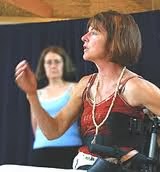
This yoga teacher and studio owner crushed her spine in a skiing accident and became quadriplegic. Her connection with her own body helped her to bring back life and movement to her body to an extent that was not thought anatomically possible. But sometimes healing is beyond what we can imagine. See and hear her story at
http://www.cbc.ca/tapestry/episode/2014/01/03/the-truth-about-karma-if-you-can-breathe/
Jan 8, 2014
Update 2014
 It seems that after 10 years of teaching in Deep River at the CEC, my time at that venue has come to a close. Due to participation being down and rent more than doubling, my teaching has to take a new shape. I look over that last 10 years and see how my teaching has undergone so much change, I've tried everything and always sought to bring something new to each class.
Now I'm settling into a slower and more introspective type of yoga, not something that may interest most. When before I went sideways -trying every new trend- now I only want to go deeper, deeper into the stretch, deeper into myself. Anything else is kind of superficial and a distraction.
Currently I am updating my registration with The Yoga Network of Canada and likewise my insurance. It appears that that won't be updated until the end of February. So it is a good time to concentrate on my own practice and invite anyone to come do yoga with me on an informal basis.
When my insurance is in place, I would like to do two "classes" per week (one morning, one evening) at St. Barnabas church on a $5 drop-in basis. The class will be from 1 to 1 1/2 hours long. I hope to have a chat with whoever shows up to come up with a plan for how the class will go forward, what people want, how they see it. I myself see it as a more interactive, participatory class, with a balance of stretch, strength and breathing. If for some reason, I don't make it, someone else can take over!
I'll let you know as soon as I firm things up.
Oct 8, 2013
Strength vs. Stretch

I am learning so much from doing yoga with one other person - the feedback!
Something that has come up is strengthening vs. stretching. Most people come to yoga for the stretching. The feeling of having stretched well, all the large muscle groups of the body is so satisfying. However, I am coming to the conclusion that stretching cannot be done safely or effectively without the complement of strengthening:
- stretching is not effective done "cold". Stretching requires the heat of strengthening to become effective. For example, at the beginning of practice, when the muscles are still cold, a standing forward triangle, which involves strengthening, is much more intense than a seated forward bend.
- stretching can be unsafe if done without strengthening. The balance of stretching a joint should be balanced with creating stability for the joint by strengthening.
As usual, a balance is needed between the two. Constant attention and awareness will be necessary to find out what the right balance is for you.
Sep 6, 2013
Force vs. Feeling

Every so often an article comes along that is totally in alignment with my thinking.
I just loved the following article by Aadil Palkhivala
If there is only one focus for you while doing yoga, let the premise of feeling not forcing be it!
Apr 11, 2012
Samata - Equanimity
In sanskrit, samata means "harmony" or "equanimity".
 When I was at my daughter's horse-riding stable the other day, I was drawn to a teenager on her horse, circling around the paddock. Just watching her, it was totally obvious to me what a good horse-rider needs - the balance between mastering her horse (some "push" or action on her part), and yielding her body to the horse, which this girl had attained beautifully. When that balance is struck, everything goes well, the rider and horse are perfectly in sync.
 It always comes back to the play of push and yield: in a yoga pose, and in life: when to yield to what is happening and when to act. That is why for me a total "yin" or passive class or a total "power" or active class doesn't work. There are the two conflicting forces within us - the ying and the yang. We are always balancing these. When we are too passive, we are out of balance and when we are to aggressive we are also. We can start on the mat to observe these two forces within us. In a pose like warrior - are we struggling too much, or collapsing and waiting for it to end? Then we can play with both and find our perfect balance in the pose. Maybe we need to yield to the pose and stop struggling, on the other hand, maybe we need to fire up the "tapas" and be more active. We can only find out which is appropriate by observing and noticing what is going on inside of us and observe if we are moving towards or away from "Samata" when we either push or yield.
Mar 30, 2011
Intention

Which brings me to intention. Focusing on intention is different than focusing on a goal. Intention is not oriented on a future outcome. It is focused on how you are being in the present moment.
You set your intention based on what is important to you and then make a commitment to align your actions to this intention. During the centering pose at the beginning of class, scan your thoughts and settle on an intention that seems to fit with your disposition at the time.
To set your intention - think about these questions: Why do I practice? How can I go deeper into my practice? What's missing in my practice? How am I going to be in this practice? Be short, positive and precise. Your intention can be honed down to a word, which can act like a mantra throughout your practice.
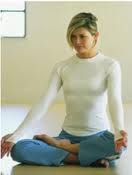 Your intention can be the same over many days of practice, or can change from day to day. For example, if you have noticed that you are complaining of being tired all the time, you can set your intention to be energetic. If you notice that you have been very self-critical, you can set your intention to be gentle with yourself. If you have been feeling sorry for yourself, you can set your intention to be grateful.
After you have set your intention, return to it throughout your yoga practice.
Some examples of intentions honed down to mantras are below. When you read the following list, some of the words will resonate with you more than others. (Think - how am I going to be in every pose).
Energetic Gentle Kind Free
Celebratory Loving Patient Enthusiastic
Playful Fierce Trusting Compassionate
Grateful Vigourous Steady Creative
Accepting Strong Balanced Generous
Content Open Tolerant Fearless
Courageous Confident Bold Still
Mar 25, 2011
Breathe!

Ujjayi breath controls the flow of air through your airway. By narrowing the passageway, we can draw out and control the flow of air. This allows us to extend the breath and go deeper into the poses. There is a slight constriction of the throat, like when you whisper, you create resistance to the passage of air, or like sipping the breath through a straw. You will hear a very slight sound, like that of a shell when you bring it to your ear. Bring your attention to the notch between the collar bones at the base of your throat.
You can start by breathing in through the nostrils, and whispering Ahh or Haa when you breath out, direct the breath over the back of your throat. The breath is still relaxed, no strain! If you find you are turning into Darth Vader, you're trying to hard.
Be patient, it takes time to perfect this breath so that it is smooth and even. With time, you can practice ujjayi on the in and out breath with your mouth closed.
Stomach Lock

Feb 7, 2011
Push or Yield

Vanda Scaravelli - There is a division in the center of our back, where the spine moves simultaneously in two opposite directions: from the waist down towards the legs and the feet, which are pulled by gravity, and from the waist upwards, through the top of the head, lifting us up freely.
Donna Farhi - In a "collapse" relationship with gravity, the body lacks tone and sags downward into the Earth. Our breath feels like stagnant water, dull and lacking in vitality, and we may be depressed and lethargic. We often try to remedy this state of collapse by swinging to the "prop" end of the spectrum, constantly pushing the ground away, projecting ourselves into space by holding the body in a state of hypertonicity, and negating our connection to the Earth. Our breathing becomes strident, high up in the chest, and tense. We feel distrustful, convinced that the only way we'll stay vertical is through constant, self-willed effort. The third choice, balanced between these two extremes, is to yield to gravity. When we yield our body weight—when we trust the Earth to support us—an upward rebounding action effortlessly lifts us away from the Earth. Our muscles come into a balanced tone, neither too gripped nor too released, and our breath centers itself in the middle of the body. Gravity becomes our friend, not our foe, and we feel in harmony with ourselves. We make the necessary effort, provide the necessary work to maintain the body's integrity, and then we let something beyond what we know and control happen to us. We trust that life will support us.
Erich Schiffman - Every yoga posture involves a "push" and a "yield". Pushing is an active force that moves the body further and deeper into the posture, gently exploring areas of tightness. Yielding is a passive force with which you wait and listen to the moment-to-moment feedback from your body; it's a letting go of resistance that allows the active force to be successful without being aggressive. The pushing and yielding elements occur simultaneously, as in a dance. Done properly, therefor, yoga is a matter of pushing and yielding, of "doing" and "not-doing" at the same time.
All these contradictions/paradoxes are with us as we balance and re-balance through all the moments of our lives, and you could probably add a few lines of your own:
| Push | Yield |
| Active | Passive |
| Yang | Yin |
| Act | Not act |
| Separate | Together |
| Particle | Wave |
| Do | Be |
| Heavy | Light |
Dec 8, 2010
Establishing a home practice
There is so much information about yoga poses on the internet or in many available books that I didn't think it was necessary for me to put together anything on yoga poses. But I guess I was wrong. After several requests for my handouts, which contain short descriptions on my favourite yoga poses with little line drawings illustrating the poses, I have finally put together a document containing all of them. I guess I'm finally getting into the digital age. You can link to the document (Hilary's pose collection), and then print them out to your hearts content. There are two pages on a balanced practice (i.e. a pick of my favourite poses), a gentle practice, and a compilation of standing poses, backbends and forward bends.
The Sun Salutations are a traditional sequence to practice at home regularly. This sequence forms the foundation for many yoga practices. Click here for more information on this wonderful vinyasa.
If you would like me to email you these documents, let me know.
Nov 18, 2010
Alternate Nostril Breathing
Breathing techniques are both practical and mysterious. Our breath is our link between body and mind and also our link to our involuntary systems - digestion, circulation, respiration - through the massage of vagus nerve by the diaphragm while breathing.
Alternate nostril breathing is good example of this. In this article on Nadi Shodhana or alternate-nostril breathing, the two channels originating from the right and left nostrils are explained, as well as the benefits of bringing them into balance. Alternate nostril breathing reduces anxiety, promotes calm, and clears the mind for meditation.
Sep 16, 2010
Some tips on how to get the most out of class

The following reminders will help you enjoy your class all the more:
- come to the class on an empty stomach
- wear comfortable, non-restricting clothing and bare feet
- you may want to bring a pair of warm socks and sweater/sweatshirt for the final relaxation.
- I provide mats, props and blankets, however you may want to bring your own for assisting in poses and for use in the final relaxation.
If you have any injuries, illnesses, or pregnancy please tell me before the class so I can modify the class for you. If you are fatigued or “under the weather”, still come, yoga can be very beneficial. Please feel free to discuss with me, before or after class, any personal concerns or suggestions you may have for changes or additions. If you would like some advice on practice at home, I have resources that I can suggest to you.
If you feel sore after a class, drink plenty of water to flush out stored up toxins and/or try soaking in a bath with epsom salts.
You are welcome to come to class as much as 15 minutes early to have some quiet time to yourself. I will suggest relaxing poses for you to take during this time.
Keep in mind that yoga is a time for quiet attention and looking inward. Many people come to yoga for stress reduction and relaxation. Please keep socializing to before or after the class.

Sep 9, 2010
The adventure of exploration

At the beginning it was a completely physical pursuit and has evolved over the last 20 years - I'm a bonified middle aged lady now at 45. But it is also constantly changing.
Right now, (if I was forced to choose one word) I would have to say that it is exploration.

So as I embark on a new year of yoga, that is where I'm headed - a free body through exploration, and naturally the not thinking too hard part would be great too!


Look at that dude - he's happy, extremely flexible and definitely not thinking too hard!
Sep 8, 2010
Yoga for Sciatica
Sometimes students email me if I have any information about particular problems they have. I welcome these inquiries, as it sends me back to the books and to the internet, where I glean all the information and whatever makes sense to me based on my experience, I can hand over back to the questioner. Here is what I've come up with for sciatica, which is a problem that has come up a few times.
Sciatica can be quite annoying, and different for everyone, so what works for someone else, might not work for you. The sciatic nerve is quite a big one, the thickness of your finger, starting at the low back and ending at the back of each leg. Sciatica is usually caused by a bulging disc in low back or a tight piriformis. Avoid all forward bending, try all stretching very slowly and carefully, you might have to experiment a bit with the following to find out what will work for you:
A sequence to follow can be found at:
http://www.yogajournal.com/practice/2308
Also try (keeping back straight for each one)
- Dog pose to a wall - toes pointed in, heels out
- Raise the painful leg on stool, chair, step - whatever you can handle.
- Sit cross legged, cross foot over knee of painful side, if you can take it, hug knee toward chest, but don't go into twist.
-Lie with legs up wall, bum at wall or slightly away, bend leg of good side and place ankle of bad side over thigh (as high up as you can go) over knee of good leg. Slide foot of good leg down the wall as far as you can go.
Also keep those hips open with hip openers!
Jan 28, 2010
Knees vs. hips in yoga
This post is intended for those of you (me included) who are perplexed with the alignment of the knees w.r.t. your feet.
This usually indicates a weakness in the internal hip rotators (those hip muscles that internally rotate your legs) and a tightness in the external hip rotators (hip muscles that externally rotate the legs). The following article is written by a license physical therapist, and is quite detailed, but if you can stay with her, you may get an insight in correcting this imbalance, creating safety around the knee and potentially staving off problems with your lower back and sacroiliac joints. Just something else to think about!
Jan 17, 2010
Yinyasa
Balancing ying and yang in your yoga practice
This week we will be doing a "Yinyasa" class. This is a fusion of Yin yoga (long held poses) with Vinyasa flow (a rhythmic flow of postures).
The first 30 minutes of Yin work help release the connective tissues, create space and integrity in the joints and remove blockages to internal energy flow. This is followed by about 45 minutes of a flowing repetition of movements requiring strength and balance.
We are always dealing with opposite energies within ourselves - to be active, to be receptive, to move, or be still, to be energetic or calm, to look inward, or look outward. This class lets us explore all these parts or ourselves. Notice which parts of the class resonate with you and which parts you resist. Also know that could change!
For more info on Ying yoga, check out:
Here are some good books by some pretty neat yogis:


Couldn't say it any better than Paul Grilley:
Inhaling is Yang, exhaling is Yin, but they both form the breath. There are critical difference between Yin and Yang tissues of the body. Muscles and blood are Yang, connective tissues and joints are Yin. Yin and Yang tissues do not respond to training in the same way and a student’s practice becomes more effective when the difference is understood.Most forms of Yoga practiced today are Yang, they emphasize muscular movement and contraction. By contrast Yin Yoga targets the connective tissue of the hips, pelvis and lower spine. Yin postures are held three to five to ten minutes at a time. This type of practice complements the more muscular styles of Yoga and is a great aid for learning to sit in meditation.
Jan 14, 2010
Yoga for the knees
Several students have had knee surgery or have had knee replacements and are understandibly nervous or anxious about doing some yoga poses.
http://www.yogajournal.com/health/1161

Yoga works on opening the hips and keeping both the the inner and outer quadriceps equally strong, to keep the kneecap in alignment.
The following gives some good pointers to those of you with concerns about your knees. If you want to get right to the solutions, skip to page 3.
http://www.yogajournal.com/health/1161

There is also a little book called "Yoga for healthy knees" by Sandy Blaine which explains in further detail how to heal your knees. This is a great book that I lent out regularly, but finally ended up with someone that I can't remember who it is.
Jan 10, 2010
Quotes to live by
Here are a few of my favourite quotes. Sometimes reading them through every so often just puts things in perspective again! I've tried to edit a few out, as the list is long, but I just couldn't bear to part with any. Some will speak to you, some won't, and then some will REALLY speak to you.
You never know what is enough unless you know what is more than enough. - William Blake
Freedom from the desire for an answer is essential to the understanding of a problem. - Jiddu Krishnamurti
I maintain that truth is a pathless land, and you cannot approach it by any path whatsoever, by any religion, by any sect. Truth, being limitless, unconditioned, unapproachable by any path whatsoever, cannot be organized; nor should any organization be formed to lead or coerce people along a particular path. - Jiddu Krishnamurti
In oneself lies the whole world and if you know how to look and learn, the door is there and the key is in your hand. Nobody on earth can give you either the key or the door to open, except yourself. - Jiddu Krishnamurti
The only way to a successful practice is to practice - Unknown
Once you label me, you negate me – Soren Kierkegaard
Our life always expresses the result of our dominant thoughts. – Soren Kierkegaard
We don't see things as they are, we see them as we are. – Anais Nin
No problem can be solved from the same consciousness that created it. - Albert Einstein
The last of the human freedoms is to choose one’s attitude in any given set of circumstances. - Victor Frankl
Out beyond ideas of wrong doing and right doing, there is a field. I’ll meet you there. - Rumi
The secret in life is enjoying the passage of time. - Richie Havens
Everything that irritates us about others can lead us to an understanding of ourselves. - Carl Jung
To be normal is the ideal aim of the unsuccessful. - Carl Jung
Asanas must have the dual qualities of alertness and relaxation. - Patanjali
Example is not the main thing in influencing others, it’s the only thing. – Albert Schweitzer
It is not easy to find happiness in ourselves, but it is not possible to find it elsewhere. – Agnes Repplier
The single biggest problem in communication is the illusion that it has taken place. – George Bernard Shaw
Whenever you are confronted with an opponent. Conquer him with love. - Gandhi
Nobody can hurt me without my permission. - Gandhi
There is no enlightenment outside of daily life. – Thich Nhat Hanh
Being at peace and being who you are, that is, being yourself, are one. – Eckhart Tolle
The worst loneliness is not to be comfortable with yourself. – Mark Twain
Whatever you fight, you strengthen, and whatever you resist, persists. – Eckhart Tolle
The primary cause of unhappiness is never the situation but your thoughts about it. – Eckhart Tolle
To love is to recognize yourself in another. – Eckhart Tolle
Resentment is like eating rat poison and waiting for the rat to die. – Anne Lamott
Peace comes from within. Do not seek it without. - Buddha
You yourself, as much as anybody in the entire universe, deserve your love and affection. - Buddha
What we think, we become. - Buddha
To conquer oneself is a greater task than conquering others. - Buddha
The highest revelation is that God is in every man. - Ralph Waldo Emerson
Nothing external to you has any power over you. - Ralph Waldo Emerson
The only time we suffer is when we believe a thought that argues with what is. – Byron Katie
It is not our thoughts, but the attachment to our thoughts, that causes suffering. – Byron Katie
When you argue with reality, you lose—but only 100% of the time. – Byron Katie
The best way to find yourself is to lose yourself in the service of others. - Gandhi
All great spirituality is about what we do with our pain. If we do not
transform our pain, we will transmit it to those around us.” – Richard Rohr
Your vision will become clear only when you look into your heart.
Who looks outside, dreams. Who looks inside, awakens. - Carl Jung
whether it is not something that could better be changed in ourselves. - Carl Jung
It is a mistake to identify yourself with this life span, to imagine that
you are separated from anything else in space or time. – Thich Nhat Hanh
If we can really understand the problem, the answer will come out of it,
because the answer is not separate from the problem. - Krishnamurti
Breath is the bridge which connects life to consciousness, which
unites your body to your thoughts. – Thich Nhat Hanh
There are two ways to live: you can live as if nothing is a miracle;
you can live as if everything is a miracle. – Albert Einstein
You do not become good by trying to be good, but by finding the goodness that
is already within you, and allowing that goodness to emerge. – Eckhart Tolle
The particular egoic patterns that you react to most strongly in others and misperceive
as their identity tend to be the same patterns that are also in you, but that you are unable
or unwilling to detect within yourself. – Eckhart Tolle
In a genuine relationship, there is an outward flow of open, alert attention
toward the other person in which there is no wanting whatsoever. – Eckhart Tolle
You have your way. I have my way. As for the right way, the correct way,
and the only way, it does not exist. - Friedrich Nietzsche
Consider how hard it is to change yourself and you'll understand
what little chance you have in trying to change others. - Anonymous
To be yourself in a world that is constantly trying to make you something else
is the greatest accomplishment. - Ralph Waldo Emerson
All that we are is the result of what we have thought.
The mind is everything. What we think we become. - Buddha
It takes time to take care of yourself, but it takes more time if you don’t take care of yourself.
Take the time to be healthy or take the time to be sick. – Suza Francina
Believe nothing, no matter where you read it, or who said it, no matter if I have said it,
unless it agrees with your own reason and your own common sense. - Buddha
What lies behind you and what lies in front of you, pales in
comparison to what lies inside of you. - Ralph Waldo Emerson
Jan 3, 2010
Most requested yoga articles
Here area a couple of very useful yoga articles:
Sore neck? Tense shoulders? I've directed many people to the following article by Barbara Benagh of Yoga Journal, and this article has been very helpful to me:

The article: http://www.yogajournal.com/practice/1969
Torn rotator cuff: Who hasn't had this problem - and frustrating too, here's help in this article: http://www.yogajournal.com/lifestyle/1102
Handstand - why is it so challenging, even when we know we're strong enough? The following article throws some light on the psychological aspects of this pose: http://www.yogajournal.com/practice/916
Here is an odyssey of someone trying to master it http://www.yogajournal.com/practice/2609?print=1
Breathing
Why do breathing practices in yoga? http://www.yogajournal.com/practice/219
What is the physiological basis of alternate nostril breathing: http://www.yogajournal.com/wisdom/927
Bandhas (inner contraction of a group of muscles)
An important part of yoga, but often misunderstood and incorrectly practiced:
Mula Bandha http://www.yogajournal.com/practice/2416
Dec 22, 2009
Why do I love yoga?
I love yoga because:
It keeps my body flexible, gives me the body language of a younger person, keeps me strong, and increases my breathing capacity.
I love yoga because:
I always have a resource to call upon; to help me fall asleep, to help me through a headache, to help me through an uncomfortable situation, to help me through an injury.
I love yoga because:
It feels so good to do it! No matter how I feel before I start, I always feel better when finished.
I love yoga because:
The older you get, the better you get at it. And you can't say that about too many forms of exercise. There are plenty of yogis in their 60's, 70's and even into 80's and 90's that are out there to emulate.
Subscribe to:
Posts (Atom)